


Telematics vs CAD/AVL: Why counting kilometers is no longer enough

The honesty check: Why absolute precision is a trap
It is a recurring question when deploying a new Computer-Aided Dispatch and Automatic Vehicle Location (CAD/AVL) system. A transit director will always end up asking: "Is your tool accurate enough for me to pay my subcontractors by the kilometer?"
The answer requires honesty. Promising absolute metrological precision is a commercial and technical trap. The reality of the field is stubborn, with its tunnels, urban canyons that scramble GPS signals, or a driver simply forgetting to turn on their tablet. Selling absolute accuracy inevitably leads to frustration. The true power of a CAD/AVL system like Pysae does not lie in pure chronometry, but in contextual intelligence.
The counter versus the validator: your data's IQ
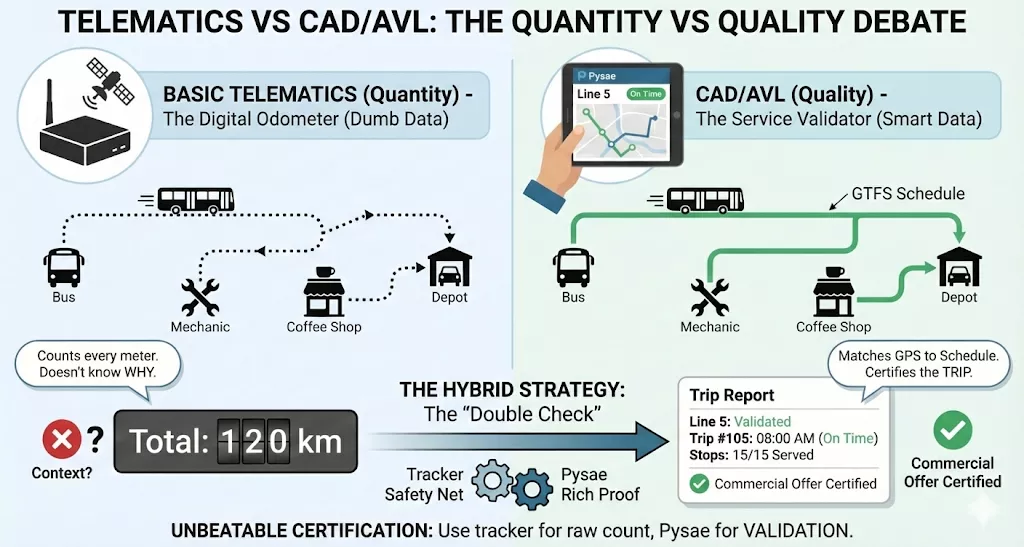
We need to separate two fundamental concepts that operators often confuse. On one hand, you have the classic GPS tracker or tachometer. It is a counter. It records every meter the wheels travel. This is blind data. The tracker has no idea if the bus is running its commercial line, returning empty to the depot, or if the driver took an unplanned detour. This system measures a quantity.
On the other hand, the CAD/AVL acts as a validator. It takes the GPS position and overlays it onto your theoretical transit schedule. In technical terms, we match raw coordinates with your GTFS files. This is where the magic happens. The system does not just say "this vehicle drove 15 kilometers". It certifies a business action: "the bus completed trip 105 on line A, at 8:00 AM, correctly serving all scheduled stops". The tool transforms movement into qualified information. It validates quality and certifies your commercial offer.
The hybrid approach: turning a blind spot into a strength
Many urban and interurban fleets are already equipped with basic telematics boxes. The classic mistake is wanting to rip them out. Keep them, they are valuable. A lightweight CAD/AVL relies very often on mobile equipment in the cabin. If the driver forgets to log into their shift, the solution lies in a double-layer strategy.
- Your physical tracker remains your digital backup odometer. It guarantees raw distance counting no matter what.
- Pysae brings the business intelligence layer. It generates the real-time passenger information feed (GTFS-RT) and validates route compliance.
In the event of human error, such as a powered-off tablet, your basic tracker at least proves to the transport authority that the vehicle was moving. Pysae ensures that when things go normally, you have rich proof of your service.
Subcontracting: how to shift the burden of proof
Managing subcontractors is the nerve center of financial operations. An operator is often tempted to generate invoices directly from CAD/AVL data, but the risk of disputes is massive. If the system shows 90 kilometers due to GPS drift while the bus drove 100, the relationship becomes tense. The winning method is to use the data to audit the invoice, not to create it.
Let your subcontractor send their billing claiming 100 completed trips. Then, use your supervision dashboard to spot-check for consistency. If your system indicates that only 50 trips were certified, the dynamic changes. You shift the burden of proof. The subcontractor must justify the discrepancy, which pushes them to demand rigorous use of the application from their own drivers.
The 3 golden rules of service certification
Before closing an equipment project, verify that your teams understand these principles:
- Trip tracking: You are not tracking a distance, you are validating the execution of a theoretical service.
- The human factor: Data quality is tied to the drivers' adoption of the tool.
- Technical synergy: Application intelligence reaches its full potential when backed by existing hardware.
Ultimately, high-performance mobility is not steered by the meter. It is steered with the right data.

