


Alternatives to IVU or Trapeze for small and medium bus fleets
.webp)
IVU.suite and Trapeze are widely respected platforms in public transit. They are robust, feature-rich, and trusted by major metropolitan authorities around the world. But for operators running fleets of 20 to 300 vehicles, they often represent a significant mismatch: too complex, too expensive, and too slow to deploy.
If you are evaluating CAD/AVL solutions for a small or medium bus fleet and find that the legacy giants are oversized for your needs, this article is for you.
Why IVU and Trapeze may not fit your context
IVU and Trapeze were built for scale: large urban networks, multi-modal operations, complex multi-agency environments. Their architecture reflects that ambition. In practice, this translates into several friction points for smaller operators:
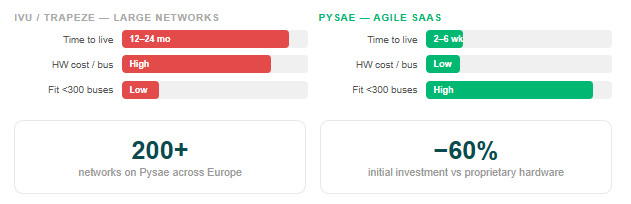
- Implementation timelines of 12 to 24 months, requiring dedicated project management resources
- Significant upfront hardware investment in proprietary onboard computers and local server infrastructure
- Licensing costs structured around enterprise budgets, often difficult to justify for networks under 100 vehicles
- High dependency on vendor technical teams for configuration, updates, and maintenance
- Long time-to-value: operators often wait over a year before the system is fully operational
None of this is a flaw in the products themselves — it reflects who they were designed for. The question is whether that profile matches yours.
What smaller operators actually need from a CAD/AVL system
When you operate between 20 and 300 vehicles, your priorities are different:
- Rapid deployment: you need to be live in weeks, not months
- Low hardware footprint: investing in proprietary onboard computers for a fleet of 50 buses is difficult to justify when tablet-based alternatives exist
- Reliable real-time tracking and trip certification: knowing where your buses are, whether trips are being completed, and having the data to report to your transport authority
- Passenger information outputs: feeding stop displays, journey planner apps, and GTFS-RT feeds without requiring a separate expensive PIS system
- A system your drivers will actually use: adoption is a real challenge; the simpler the driver interface, the higher the data quality
The landscape of alternatives
Pysae — Cloud-native SaaS for agile operators
Pysae is a French SaaS CAD/AVL platform, now used across more than 200 networks in Europe, including fleets operated by Transdev, Keolis, and RATP Group subsidiaries. It was built specifically to address the gap left by legacy systems: high-quality supervision without the infrastructure burden.
Key differentiators for small and medium fleets:
- 100% cloud architecture — no local servers, no proprietary hardware
- Driver app on standard Android tablets — no specialised onboard computers required
- Deployment in 2 to 6 weeks for most networks
- Native GTFS/NeTEx ingestion and GTFS-RT output — feeds stop displays and mobility apps without additional middleware
- Open integrations with ticketing systems, stop display providers, and enterprise data platforms
- Pricing structured for mid-market fleets — predictable OPEX model
Pysae is particularly well-suited for private operators managing contracted services, regional interurban networks, and fleets where subcontractor management and trip certification are critical.
Omnibus (Trapeze Group) — Scheduling-first approach
Omnibus is a scheduling and workforce planning tool, strong on optimising driver rosters and vehicle assignments. It is less a real-time supervision system than a planning platform. Relevant for operators who need sophisticated timetable and crew management, but who may still need a separate solution for live fleet tracking.
Syncromatics (GMV) — North American market focus
Syncromatics, now part of the GMV group, is well-established in the US market, particularly for fixed-route and demand-responsive services. Less common outside North America, and their integration ecosystems are primarily built around US regulatory requirements (NTD reporting, ADA compliance, etc.).
Optibus — Optimisation and planning
Optibus focuses heavily on AI-driven scheduling and network optimisation. Excellent for large-scale planning exercises, but not primarily a real-time dispatch and supervision tool.
The right question to ask before choosing
Before comparing vendors, define what you actually need to solve:
- Is your primary need real-time supervision and trip certification for contractual reporting?
- Do you need passenger information outputs (GTFS-RT, SIRI, stop displays)?
- Are you managing subcontracted services where trip-level proof of service matters?
- How quickly do you need to go live?
- What is your hardware budget per vehicle?
If your answers point toward speed, simplicity, and real-time operational visibility rather than deep scheduling optimisation or multi-modal complexity, the legacy enterprise platforms are likely oversized for your needs. Agile SaaS alternatives deliver the core value — live fleet tracking, trip certification, passenger information — at a fraction of the implementation cost and timeline.
Running a fleet of 20 to 300 buses and evaluating your options? Pysae's team can walk you through a live demo tailored to your network context.

